 Nationwide Shipping Across NZ


Flip Front vs Fixed Front Welding Helmets: Which is Better?
Deciding between a flip front or a fixed front auto-darkening helmet? Let’s dive into a comparison to help you decide which option suits your needs best.

When to Use What
To a large extent, the choice of helmet comes down to personal preference, but generally here”s what we”ve found welders and engineers prefer about each:
Flip Front
-
Welders who do a lot of grinding appreciate flip front helmets for their larger clear viewing area and reduced blind spots.
-
The flip-up auto-darkening lens allows users to see clearly for grinding and fitting tasks between welds.
-
Provides true, clear vision and a wider viewing area, making it versatile when moving around the workshop.
-
Reduces exposure to fumes and flying particles since it can stay on throughout various tasks.
-
Seamlessly switches from welding to grinding without needing frequent setting adjustments.
Fixed Front
-
Ideal for welders focusing primarily on welding, as they are lighter and don”t require flipping up and down.
-
TIG welders benefit from the simplicity and straightforward functionality of fixed fronts.
-
Compact and less bulky, making them easier to use in confined spaces.
-
Typically more affordable due to fewer components.
How Does ‘Grind Mode’ in Fixed Fronts Compare to Flip Front Helmets?
The decision often depends on your job”s specific requirements. If you frequently alternate between grinding and welding, the flip front”s larger viewing area and clearer vision might be more practical. However, high-quality fixed front helmets still offer adequate visibility in grind mode.
Fixed front helmets are lighter, which can make a difference during long shifts. Properly designed fixed fronts also enhance comfort and balance, especially for extended wear. Their slimline design makes them a better choice for tight spaces.
Key Features Comparison
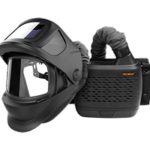
- The major difference with the flip front is the ability to flip up the auto-darkening lens to experience true vision and a wider viewing area.
- Fixed fronts are lighter and more slimline than flip front.
Flip Front
-
Advantages:
-
Excellent for frequent grinding and fitting tasks.
-
Quick transitions between welding and grinding.
-
Wider viewing angle for improved visibility.
-
Clear, wide-angle vision when flipped up.
-
All-day protection without frequent removal.
-
-
Disadvantages:
-
Slightly heavier due to the flip mechanism.
-
Fixed Front
-
Advantages:
-
Lightweight and balanced, perfect for long shifts.
-
Slim design fits well in confined spaces.
-
-
Disadvantages:
-
Grind mode may lack the clarity of flip front helmets with true vision.
-
Is the Respirator Performance Better in One Over the Other?
Respirator performance largely depends on the quality of the helmet and motor, rather than the design type. Certified helmets—whether flip or fixed front—must meet stringent safety standards to provide reliable protection.
Consider these factors:
-
Airflow Design: Evaluate how air is channeled in and out of the helmet. Some designs direct air over the top, while others push it from the bottom across the face.
-
Balance: Ensure the respirator”s design doesn”t interfere with workflow or comfort.
So Why is a Flip Front More Expensive?
The higher price of flip front helmets isn”t about better performance but added complexity. Flip fronts feature:
-
An additional lens for true vision.
-
A larger viewing area.
-
More intricate components for the flip mechanism.
These factors contribute to the increased cost but offer enhanced functionality for specific tasks.
Making Your Choice
Ultimately, choosing between a flip front and a fixed front helmet depends on your specific job requirements, personal preferences, and budget. Both options have unique strengths, so prioritize what matters most—whether it”s versatility, comfort, or simplicity.

Related Posts
‘AS/NZS 2161:2005 certified’ – looks good, but what does it mean? It’s easy to read and assume it means the…
Hearing protection is a serious matter – once it’s gone, it’s gone! The good news is, keeping everyone safe from…
When it comes to hearing protection, earmuffs are often thought of as the more comfortable option over earplugs, however concerns…


 Available to everyone
 View stock levels & shipping times
 Access to trade accounts, & order history